

Understanding Golf Club Loft and Distance Gaps
There's a nasty surprise waiting for the golfer who buys a new iron set based on how far the 7-iron goes. On the range, the extra distance feels terrific. On the course, the same golfer finds a sprinkler head marked 112 yards, pulls out the pitching wedge and realizes that the club now goes 130. The next wedge goes 100. Neither is a particularly attractive choice with a bunker sitting in front of the green.
That is a bag-building problem, and it has nothing to do with whether the new irons were good clubs. Somewhere between the iron purchase and the first round, nobody checked the distances at the bottom of the set.
Loft is a useful place to start, but the numbers that belong on your scorecard are yards, not degrees.
Find the shots you don't own
Here is a hypothetical distance chart for a golfer who has recently purchased stronger-lofted irons. These are illustrative carry distances, not recommended distances for every golfer.
| Club | Loft | Carry |
|---|---|---|
| 5-iron | 23° | 174 yd |
| 6-iron | 26° | 168 yd |
| 7-iron | 30° | 156 yd |
| 8-iron | 34° | 143 yd |
| 9-iron | 39° | 131 yd |
| Pitching wedge | 44° | 119 yd |
| Gap wedge | 52° | 96 yd |
| Sand wedge | 56° | 84 yd |
| Lob wedge | 60° | 70 yd |
Two things jump out. First, that 5-iron travels only six yards farther than the 6-iron. It might have a longer total distance because it lands at a shallower angle and runs farther, but it hasn't given the golfer much additional airborne distance. For a shot that must clear water, that matters.
Second, there is a 23-yard hole between the pitching wedge and gap wedge. That's a far bigger problem for most recreational players than losing five yards with the longest iron. Consider how often an ordinary round presents a shot somewhere between 100 and 115 yards. A golfer who likes full wedge swings will spend a lot of time trying to manufacture something that isn't comfortably available.
A 48-degree wedge is worth trying here. It might occupy the empty space without disturbing the rest of the short irons. If the bag is already at the 14-club limit, the barely useful 5-iron is an obvious candidate to leave at home while the new arrangement gets tested.
Notice that we haven't decided the answer simply by dividing 44 and 52 in half. The 48-degree club needs to hit the right distance. A specialty wedge with a different shaft length, head construction and weight distribution might not behave exactly as the arithmetic suggests.
What the number stamped on the sole doesn't tell you
Pick up a traditional 7-iron and a modern distance-oriented 7-iron. They may have considerably different lofts. That explains part of the difference in yardage, but not all of it. The length of the shaft, ball speed from the face, location of the center of gravity and the way you deliver the head can change the flight, too.
Static loft is the measured angle of the clubface in its specified position. Dynamic loft is the loft actually presented to the ball at impact. Two golfers could use identical clubs and produce quite different launch conditions because of how their hands, shaft and clubhead arrive at the ball.
This is why a chart from a manufacturer cannot replace a chart of your distances. The specifications help you identify where to investigate. They don't establish how your particular swing will respond.
A low-lofted iron that flies too low to carry much farther than the club below it is taking up valuable space. A hybrid or higher-lofted fairway wood could produce a more useful flight even if it carries a similar loft number. A longer shaft and a different head design can make an appreciable difference in launch and speed. Don't buy the replacement until you see what the ball does, though. Some players hit hybrids poorly and do much better with a suitable fairway wood.
Spend one practice session measuring carry
Book a session with a launch monitor that reports reliable carry distances, preferably with the type of ball you normally play. Outdoor range balls vary considerably in condition and construction. If they are limited-flight balls, the numbers may be particularly misleading. An indoor monitor needs enough space and a proper setup to measure or model the flight accurately.
Warm up first. Then hit six to ten representative shots with each club. There is little value in hitting fifty balls consecutively with one iron until you finally discover the swing that produces its longest possible shot. Rotate through clubs to make the session resemble golf. Rest when necessary; fatigue can turn a long testing session into an investigation of how poorly you swing when tired.
Record the middle of your normal carry results and the spread between the shorter and longer shots. Set aside a plainly abnormal shank or topped shot when estimating stock distance, but keep ordinary imperfect contact in the sample. Those are the shots you're going to have to play on Saturday.
For instance, if a 7-iron produces carries of 142, 147, 149, 150, 151, 153 and 158 yards, the 150-yard figure is a reasonable starting point for planning a normal shot. It would be foolish to write 158 on the club's label simply because that was the nicest strike of the morning.
Record the landing angle and peak height as well if the monitor provides them. A 170-yard club that drops steeply onto a green can do a different job from a 170-yard club that hits the ground running. Identical carry numbers don't automatically mean redundant clubs when their intended uses differ.
The gaps at the top and bottom require different thinking
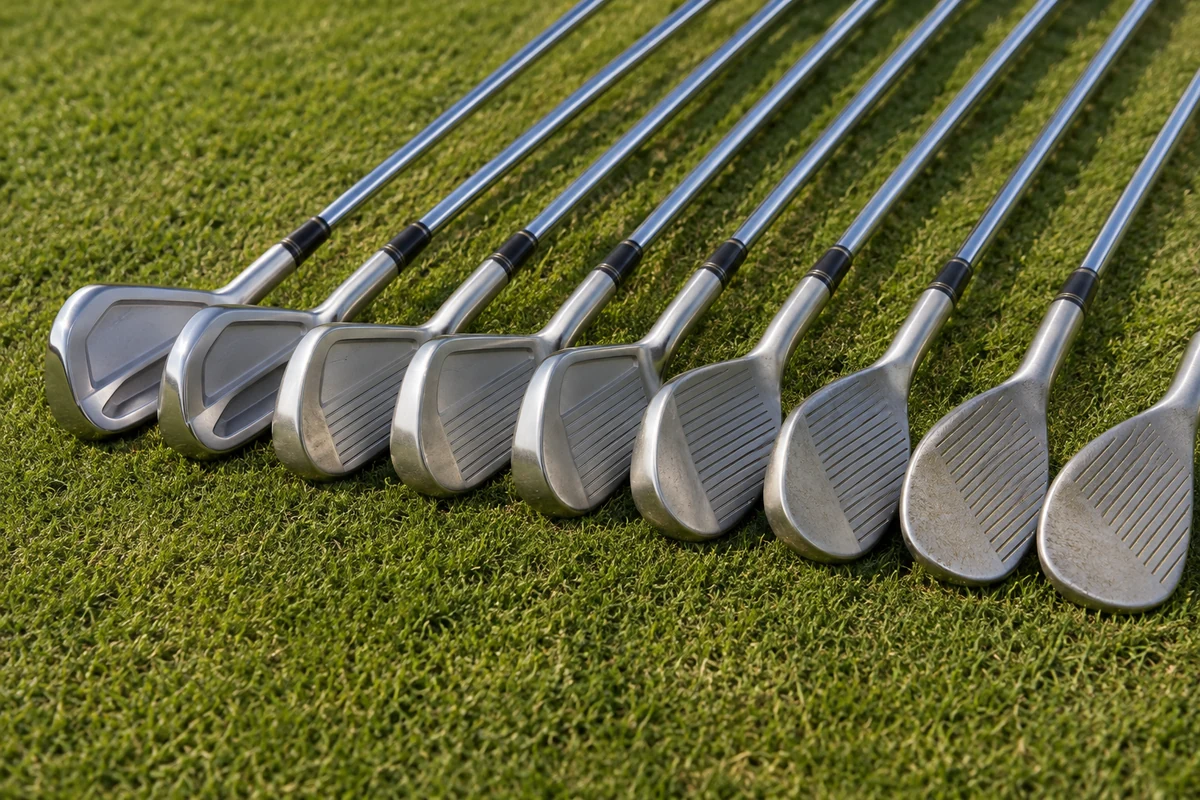
With irons, gaps of roughly ten to fifteen yards are a useful starting point for many players. Faster golfers may naturally see larger intervals; slower golfers may be perfectly happy with eight or nine. If the distances overlap substantially, the important question is whether the clubs still offer distinct useful flights. A low-running long iron may be worth keeping on a windy links course even when a hybrid supplies comparable carry.
Wedges have another complication. You don't need a full swing for every possible distance. A controlled partial shot with a pitching wedge might cover the distance between two clubs rather nicely, and the same shot can be useful in wind. Before purchasing a fourth wedge, consider whether you already have a repeatable shorter swing that does the job.
A simple experiment is to hit three groups with each scoring wedge: your comfortable full swing, a restrained three-quarter swing and a shorter pitch. Write down the typical carry from each. Don't worry about assigning a precise clock position to the backswing unless you already practice that way. What matters is finding motions you can repeat without having to guess how hard to strike the ball.
It is possible to build a very competent short game with three wedges. It's also possible to carry four and still have nothing trustworthy from 65 yards. The extra club doesn't automatically provide extra skill.
Before you have an iron bent
Ask a fitter to measure the actual lofts and lies of your existing clubs. A set that has seen several seasons of play might contain an unexpected loft difference between adjacent irons, particularly with heads made from materials that are easier to bend. Manufacturing tolerances can contribute to differences as well.
Loft adjustments are not necessarily harmless. Bending a wedge stronger generally reduces its measured bounce; weakening it generally increases bounce. Changes to offset or how the club presents itself can also matter. The head construction determines whether an adjustment is appropriate and how much bending the club can safely tolerate. Leave that work to someone who understands the particular model.
After changing a club, go back and measure the actual carry. A professional can put the loft precisely where you requested, but your golf swing still gets the final vote on the distance.
Keep the resulting yardage card somewhere accessible. On an unfamiliar course, knowing that your 8-iron normally carries 143 yards is considerably more valuable than remembering that it has 34 degrees of loft. Add notes for cold weather, wind and elevated greens as you gain experience. The objective is to choose the right club before you stand over the ball, rather than trying to rescue an unsuitable club selection with a different swing.