

Mallet vs. Blade Putters: Which Is Right for You?

A putter can look perfect on a rack and still be the wrong one for your stroke. You set it behind a ball, admire the clean lines, make three short putts on a showroom carpet, and start imagining all the shots it will save. Then you take it to a real green. The first six-footer starts right of your mark. Your next long putt finishes eight feet short.
That is why choosing a putter should begin with what the ball does, not with whether you prefer a compact blade or a large mallet.
Both designs can be excellent. Both can also be a poor fit. The useful questions are whether you aim the head comfortably, strike the ball consistently, start it on your intended line, and control speed.
What is a blade putter?
A traditional blade putter has a narrow, relatively compact head, often with a heel-toe weighted shape. Its simple appearance appeals to players who like to see very little equipment behind the ball.
But not all blades behave alike. A classic plumber's-neck blade can have noticeable toe hang, while other blade designs with different necks and shaft positions can have very different balance characteristics. The shape does not tell you everything about how the head will move.
A blade can be easy to aim for someone who prefers a straight leading edge. Another golfer might struggle to judge the center without a longer alignment line. Neither golfer is making a mistake. Their visual preferences are different.
What makes a mallet different?
Mallet putters spread the head farther behind or around the face. Many use perimeter weighting, multi-material construction, or a larger footprint to increase the head's resistance to twisting on off-center strikes.
Some mallets have broad alignment features. Others use a simple line or a pair of contrasting edges. Mallets can be face-balanced, toe-hanging, or designed with other shaft and neck configurations.
The idea that every mallet suits a straight stroke and every blade suits an arc is too simple. Head shape and balance are related design choices, but they are not interchangeable descriptions.
The real value of forgiveness on a putt
A putt does not need the ball speed of a driver, but small changes in contact still matter. If you strike away from the sweet spot, the head may twist slightly and transfer energy differently. The ball can start a little off line or travel a different distance.
A putter with a higher moment of inertia, or MOI, can resist some of that twisting. Larger mallets often make more room for that design characteristic. They do not automatically fix a poor face angle or a stroke that changes speed from putt to putt.
Imagine a twenty-five-foot putt across a sloping green. You have read the break correctly but catch the ball toward the toe. A putter that retains speed and direction better on that strike may leave a more manageable second putt.
That is valuable. It is also different from promising that a mallet will make every player putt better. Strike location, head weight, loft, lie, grip and technique all affect the result.
How to test forgiveness
Place a temporary, removable impact marker on the face if the shop allows it. Hit putts from your normal posture and see where contact collects. If most strikes land toward the toe, try a head designed to be stable across that area, then compare both the starting line and the finished distance.
Do not deliberately mis-hit every putt just to prove a design claim. Include your actual strike pattern.
Toe hang, face balance and why the distinction matters
Hold a putter horizontally with its shaft resting across a finger or supported in the balance position. With some models the face tends to point upward; with others the toe hangs toward the ground.
This balance is influenced by head design, neck geometry and shaft placement. It may be useful during a fitting because the putter's tendency to rotate can interact with how you move the club.
Many players naturally make a small arc in their stroke. The putter does not generally travel perfectly straight back and through on an inclined plane, despite what a simple training line might suggest.
A toe-hanging head might fit one arcing stroke well. But it does not follow that every golfer with an arc needs maximum toe hang. Similarly, a face-balanced putter is not automatically the answer for everyone who describes their stroke as straight.
A useful fitter should observe what you actually do, then compare designs. The PGA's putter-selection advice discusses toe hang and stroke shape as starting points, not substitutes for measuring your results.

Aim can matter more than the shape you admire
Some golfers struggle to aim a putter without knowing it. They stand behind the ball, picture a starting line, then set the face a little open or closed when they address it.
A putter's lines, top edge, face height and head size affect the picture you see. A long mallet alignment feature might help you match the face to your intended line. It might also cause you to aim differently because the shape looks crooked to your eye.
You can test this without guessing.
- Choose a straight, relatively flat putt of roughly six feet.
- Place the putter behind the ball and align it as you normally would.
- Have a fitter or another golfer check the face direction from a consistent position.
- Repeat with both a blade and a mallet.
- Look for a repeatable aiming bias rather than one isolated result.
Do not use the first ten minutes with a new shape as final proof. Give yourself enough time to become familiar with it, then return to the original putter to see whether the difference persists.
Length and lie angle deserve attention
It is easy to blame head design for poor putting when the putter is simply difficult to set up with.
A putter that is too long may crowd your arms or make you stand unusually upright. A shorter one might make you bend more than feels natural. Grip position, arm hang and eye placement all matter.
Lie angle is another fitting variable. If the putter sits severely toe-up or heel-up in your normal posture, that could affect your setup and how the face is delivered.
Avoid making length decisions solely from your height. Two golfers who are the same height can have different arm lengths, posture and preferred hand positions.
Try a length that allows your shoulders, arms and hands to move comfortably. If you change length, repeat the aiming and speed tests before attributing the result to a different head.
Does a heavier putter help distance control?
Weight can change your tempo and the effort you feel you need for a given putt. Some golfers prefer a heavier head because it feels stable. Others struggle to control long-putt speed with too much head weight.
There is no universal heavy-is-better rule.
On the practice green, test putts of about ten, twenty-five and forty feet. Do not aim only at the hole. Try to finish within a small, realistic target area around it.
A putter that makes four-foot putts feel solid but leaves your long putts unpredictably short is not necessarily a good fit.
Pay attention to how far the ball finishes beyond or short of your target. Distance control deserves its own part of any fitting, separate from whether you can start a short putt online.
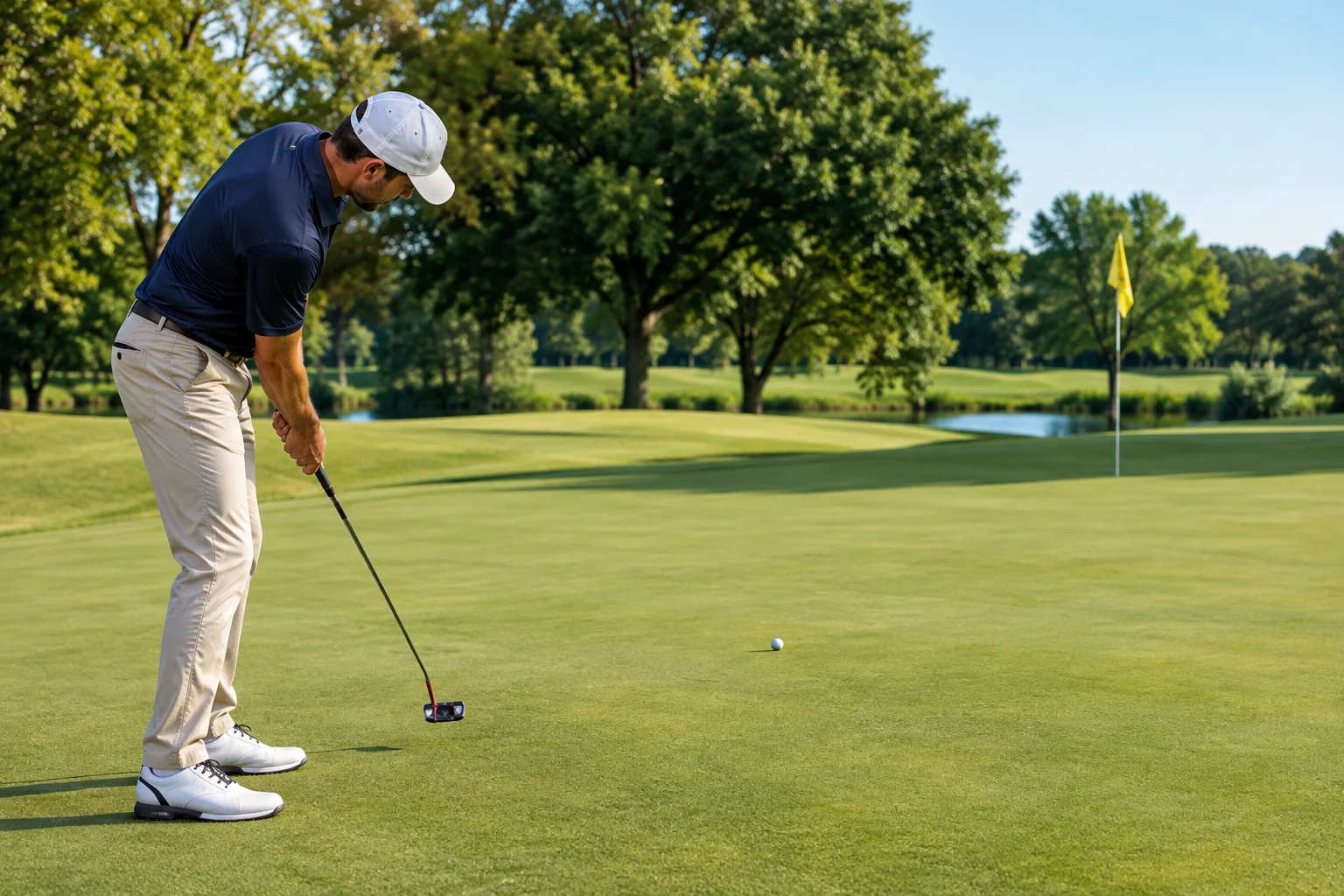
Face inserts, milling and the sound of impact
Two putters of similar shape can feel different because of face construction. Some use a metal face with milling patterns. Others use inserts made from different materials.
Sound is part of how a golfer perceives feel. A sharper click may seem firmer even when the actual performance difference is small. A softer sound may encourage a different stroke.
You should judge this alongside distance. If one model sounds comfortable but repeatedly rolls too far or too short with your usual effort, the benefit may be mostly sensory.
Golf-ball choice also changes sound and feel. If you normally play a particular model, use that model when testing putters. Our golf ball selection guide explains why changing balls during an equipment comparison can confuse the result.
Alignment aids: more is not always better
Large lines, dots and contrasting colors can be useful. A player who struggles to set the face square may benefit from a clear reference.
Another golfer may feel distracted by too many markings. A plain topline may let that player focus on the target more naturally.
Consider what happens on a real green with break. You rarely aim directly at the hole. You must choose a starting line, commit to it, and roll the ball with the right speed.
An alignment aid is worthwhile only if it helps that process. It should not become a feature you like in the store but cannot use outdoors.
Build a proper blade-versus-mallet test
A serious putter comparison needs more than hitting a handful of four-foot putts.
Round 1: starting line
Set up a short, straight putt with a legal practice gate or two widely spaced tee markers. Use a consistent target. Hit enough putts with each head to see whether one starts the ball more reliably where you intended.
Do not make the gate so narrow that every attempt becomes tense. The goal is to measure your pattern, not punish yourself.
Round 2: contact
Observe strike location on each face. A head that repeatedly encourages center contact can be valuable even if its shape was not your first choice.
Round 3: medium-distance control
From roughly fifteen feet, try to finish within a sensible distance around a target. Use a flat and a gently sloping putt. Notice whether one design makes it easier to judge pace.
Round 4: long lag putting
From thirty to forty feet, compare the size of your leave, not only whether a lucky putt drops. Long-putt speed is often where a new putter reveals an uncomfortable weight or feel.
Round 5: pressure test
Return to a six-footer after the long-putt work. Make ten normal strokes with each model. A putter worth keeping should still look and feel comfortable after the novelty has faded.
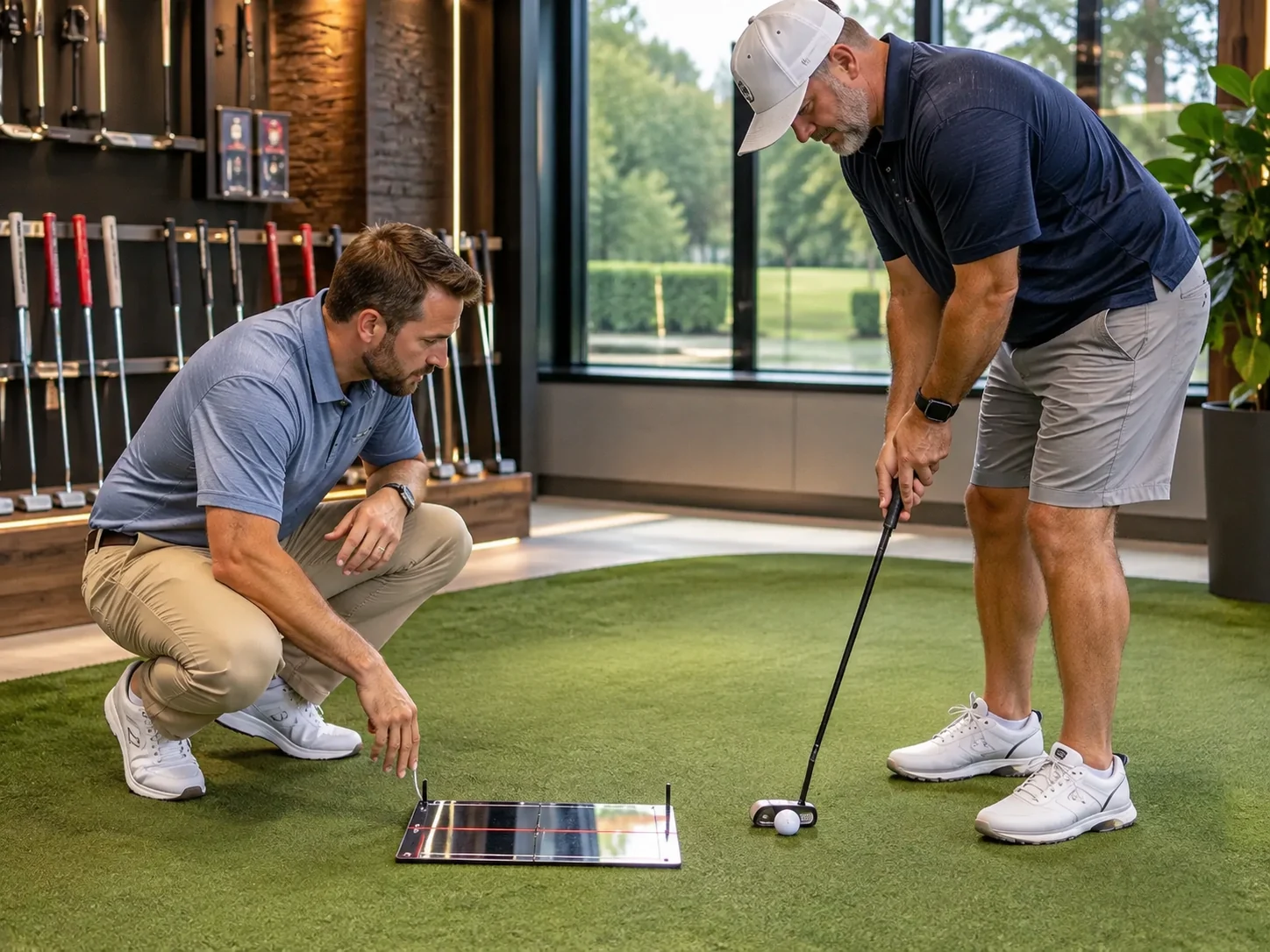
You can write the results in a simple table:
| Test | Blade | Mallet |
|---|---|---|
| Natural aim | Record your observed pattern | Record your observed pattern |
| Center contact | Percentage or general consistency | Percentage or general consistency |
| Short-putt start line | Hits through practice gate | Hits through practice gate |
| Fifteen-foot pace | Typical finish distance | Typical finish distance |
| Long-putt pace | Typical finish distance | Typical finish distance |
| Comfort | How it feels after repeated testing | How it feels after repeated testing |
These measurements matter more than a claim that one head type is automatically better.
Should beginners buy a mallet?
A forgiving mallet is a sensible design to test if a new golfer struggles with center contact or aiming. However, the golfer may prefer a blade visually and perform better with it.
Beginners should also pay attention to length and basic setup. A correctly fitted, reasonably priced putter plus practice may be more valuable than the latest premium model.
For the rest of your bag, our beginner club buying guide explains where to spend money first.
Can a better player benefit from a mallet?
Absolutely. Skilled golfers are not required to use blades. They may value the alignment picture, stability or pace control of a larger head. A compact putter is a preference, not proof of expertise.
Some golfers also change putters too often. If you already start the ball online and control distance well, swapping head shapes because someone won a tournament is not a reliable improvement plan.
Common questions
Will a mallet stop me from pushing putts?
Not automatically. A push can come from aim, face delivery or stroke behavior. A different putter may help you aim or deliver the face more consistently, but the cause needs identifying.
Do all blades have toe hang?
No. Neck and shaft design influence balance. Do not infer toe hang from appearance alone.
Are mallets better on long putts?
Some golfers control speed better with a particular mallet, while others prefer a blade. Test long putts with the same ball and comparable conditions.
Should I choose by handicap?
No. Use aim, contact, face control and pace as your evidence.
How often should a putter be replaced?
There is no routine replacement requirement. Keep a putter that fits and performs well unless a measured improvement or a genuine fit problem gives you a reason to change.
Make the choice on a real green
A blade can give you a simple alignment picture and a feel you trust. A mallet can offer stability and alignment features that help your stroke. Neither advantage is guaranteed for every golfer.
The best putter is the one that helps you aim where you intend, strike the ball reliably and control the distance across a range of putts. If you can demonstrate that result with your own golf ball on a real green, you have a far better reason to buy than the shape of the head.