Blade vs. Cavity Back Irons: Which Should You Actually Play?
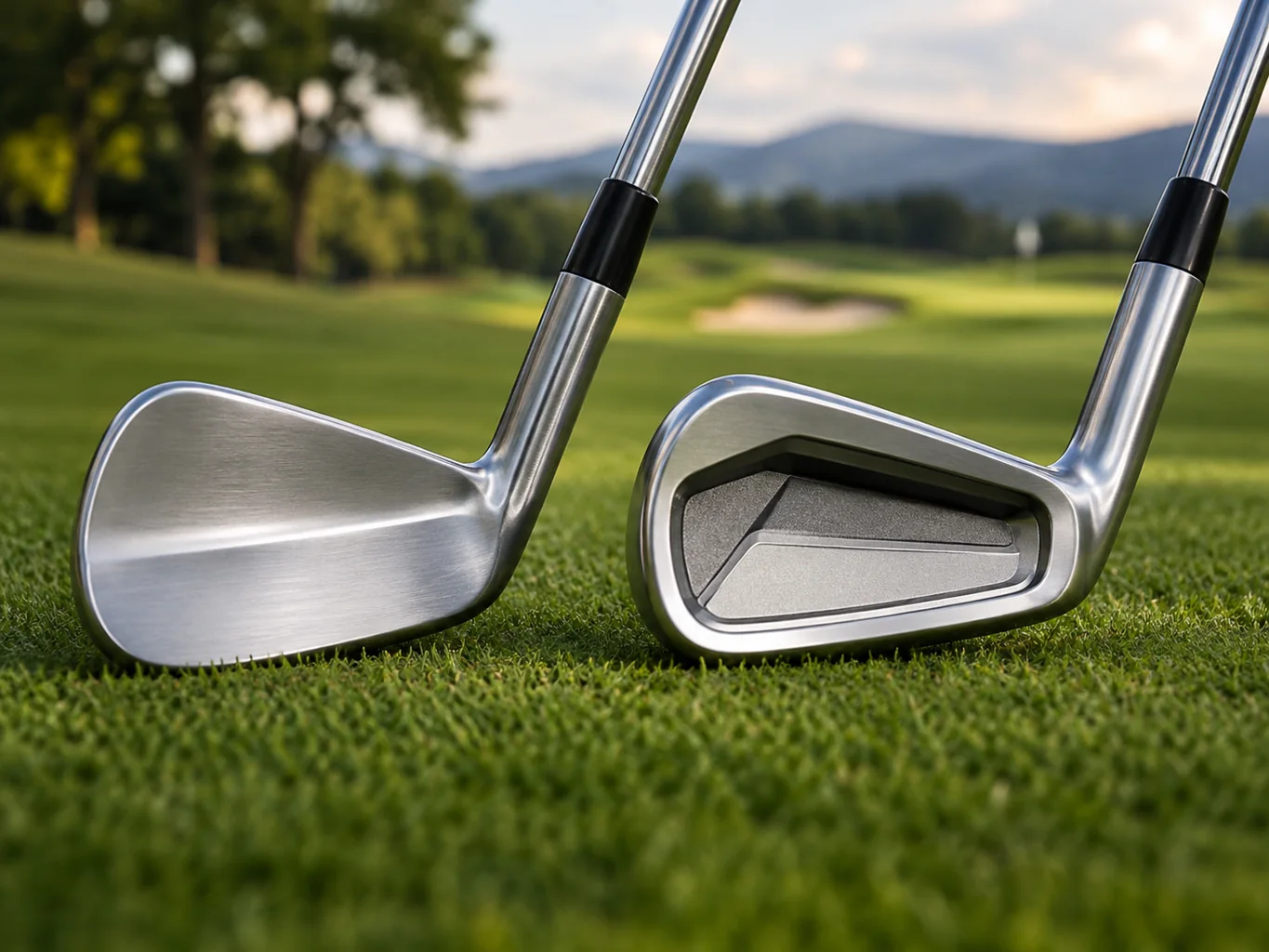
A beautiful set of muscle-back irons can make even a sensible golfer start dreaming. The heads are compact, the toplines are thin, and a perfectly struck shot feels wonderful. Then you catch one toward the toe, come up a few yards short of the green, and remember that golf is played with all your shots, not just the good ones.
The question is not whether blades are good clubs. They are. The question is whether a blade, a cavity back, or something between the two gives you better results across a normal round.
What makes a blade different from a cavity back?
A traditional blade, often called a muscle-back iron, has a relatively compact head with more of its mass concentrated behind the hitting area. From behind, the head usually looks like a solid piece of metal. A cavity-back iron moves some of that mass toward the perimeter of the head, often toward the heel, toe, or lower edge.
That change in mass distribution affects how the head responds when contact misses the center. Weight farther from the center can increase the clubhead's resistance to twisting. This resistance is described by moment of inertia, or MOI.
The category names only tell part of the story. Some cavity backs are compact, nearly blade-like player's irons. Others are larger game-improvement heads. Hollow-body irons add another construction method. You cannot judge every model by the shape of its back.
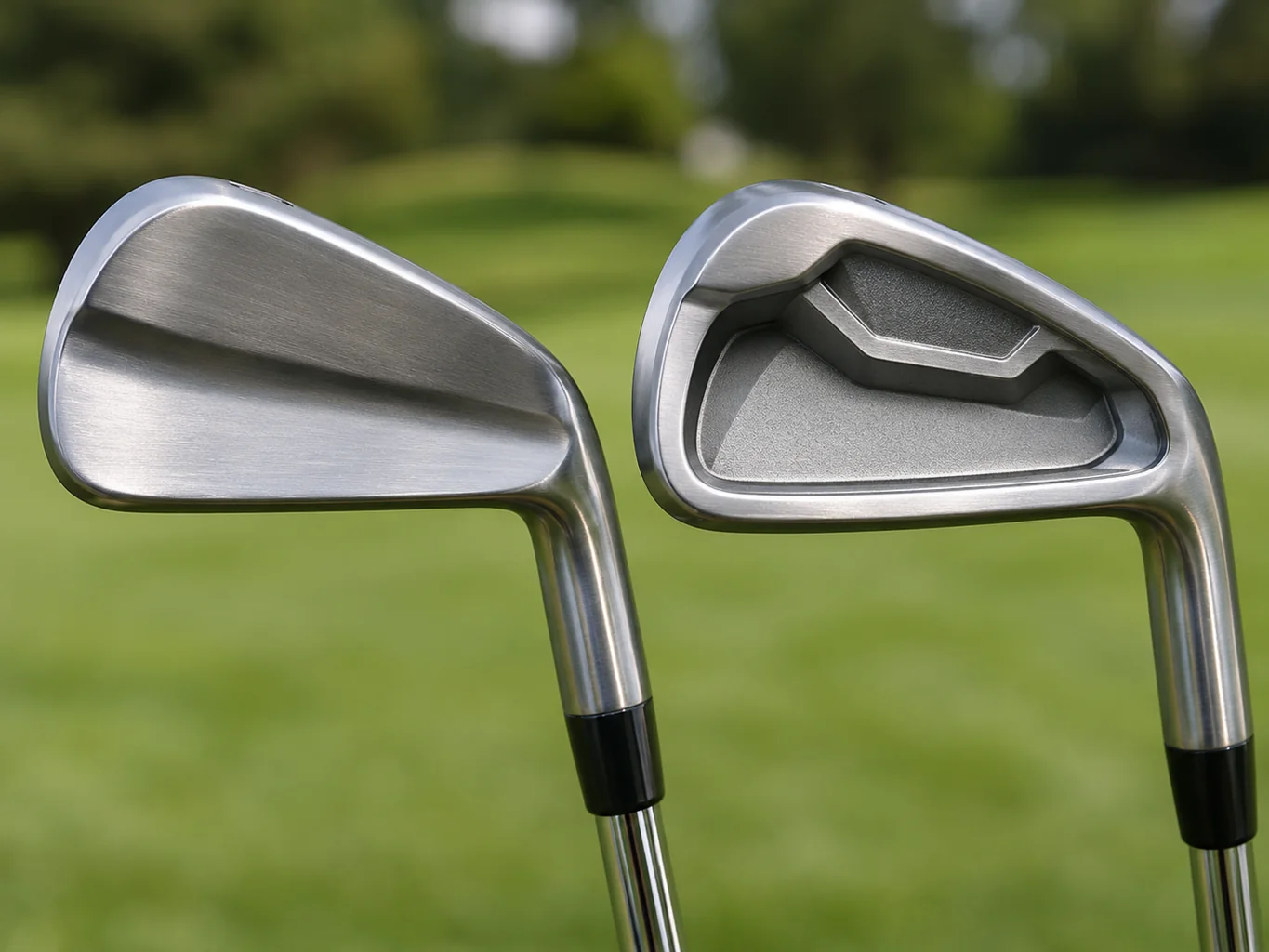
Blade and cavity-back irons compared
| Question | Traditional muscle-back blade | Cavity-back iron |
|---|---|---|
| What does the head look like? | Usually compact with a thin topline | Ranges from compact to relatively large |
| How is mass distributed? | More concentrated behind the strike area | Often distributed farther around the perimeter |
| What happens on a mishit? | Can lose more speed and stability | Often retains more useful performance |
| Can you curve the ball? | Yes | Yes |
| Do you automatically get more spin? | No | No |
| Does it suit every good player? | No | No |
| What should decide the purchase? | Your actual shots, confidence, and preferences | Your actual shots, confidence, and preferences |
These are design tendencies, not promises about a particular brand or model.
Forgiveness matters most on the shots you nearly hit well
Imagine a 155-yard approach with a bunker just short of the green. You hit a seven-iron from the middle of the face and it flies the expected distance. Then you repeat the swing and strike a little toward the toe.
On an off-center hit, the head can twist and ball speed can drop. A more perimeter-weighted design may reduce some of that penalty. The miss might still be short, but being a few yards less short can decide whether your next shot comes from the green or the sand.
Forgiveness does not mean the club corrects a bad swing. A face delivered substantially open can still send the ball right. A strike that hits the ground well before the ball will still lose energy. Clubhead design cannot erase those mistakes.
Think about the spread of your shots. Suppose a blade gives you one beautiful 160-yard carry but most of your other good-enough strikes travel 145 to 152. A cavity back might top out at 158 while a larger share of your normal shots travel 151 to 157. Those numbers are an illustration, not test results. They show why a consistent pattern can be more valuable than the longest ball of the session.
If there is a forced carry on the hole, the club with the tighter distance pattern might be the better scoring tool.
Are blades more accurate?
Not automatically. Starting direction and curvature are influenced by the way the face and path arrive at impact, alongside contact location and other conditions. A compact blade may look beautifully square behind the ball, but that appearance does not guarantee a square face at impact.
Instead of asking which club is more accurate in general, ask which specific model produces a tighter pattern for your ordinary strikes.
On a launch monitor, compare the left-to-right spread of the shots and the variation in carry distance. Then think about the real consequences. A shot that finishes ten yards left of the target may be harmless on one hole and disastrous on another.
What about feel and feedback?
Golfers often love the sensation of a centered strike with a forged blade. The solid impact and sound can be part of the appeal. But feel is not determined by head category alone. Material, construction, shaft, ball, strike location, and even sound can influence what you experience.
A well-designed forged cavity back can feel excellent too. A hollow-body iron may use internal damping to create a particular sound and sensation.
Traditional blades may make poor contact more obvious, which some golfers value as feedback. Still, you do not need a punishing mishit to learn where you struck the ball. Face spray, impact tape, careful observation, and good instruction can provide clearer feedback.
Try a few shots from the toe, heel, and lower portion of each face during a fitting. The best feeling on one centered strike is not enough to make the choice.
Can cavity backs shape shots?
Yes. The relationship between face direction and club path is central to shaping a draw or fade, and that relationship can be controlled with many iron types. A blade is not required to work the ball.
Different designs may influence launch conditions and how a particular player delivers the head. A golfer who prefers a smaller head may find it easier to visualize a specific shot. Those preferences can matter, but they should be tested.
Most recreational golfers gain more by developing a repeatable stock shot than by buying irons for a draw or fade they rarely need to hit.
The distance trap: check the loft
A modern seven-iron may go noticeably farther than an older seven-iron. Before celebrating, compare the stated lofts. Iron numbers are not standardized across manufacturers, and some modern models have stronger lofts than traditional designs.
The more useful questions are how far each club carries, how high it flies, and how it comes down near the green.
A lower-lofted iron may produce more distance without providing the stopping characteristics you need for a particular approach. A successful fitting looks at launch angle, spin, peak height, landing angle, and distance consistency together.
Do not make a buying decision from the single longest shot shown on the screen.
Sole design can change the way an iron plays from grass
The sole is the bottom part of the clubhead, and it deserves more attention than it gets in the shop. Sole width, curvature, bounce, and leading-edge design can all affect how a club interacts with turf.
A golfer who approaches the ball steeply and takes deep divots may prefer different sole characteristics from someone who sweeps the ball off firm fairways. A wider sole can help in some situations, but it is not automatically best for every swing or ground condition.
A mat can tell you about ball flight. It may not tell you everything about how an iron enters and exits real turf. If possible, test candidates from grass similar to the fairways you normally play.

Does handicap tell you which iron to play?
It is a clue, not a rule. Someone who struggles with putting and driving may still strike their irons very well. Another golfer might score consistently because of a strong short game while missing the center of the iron face regularly.
A high handicap does not prevent someone from hitting a blade well. A low handicap does not require one.
If your contact moves around the face, more forgiveness is an obvious characteristic to test. If you strike the ball consistently and strongly prefer a traditional shape, a blade or compact player's iron may be worth comparing.
Our guide to choosing the right clubs for your game explains how to evaluate the whole set rather than choosing by handicap alone.
Why skilled golfers still choose cavity backs
There is no graduation ceremony from cavity backs to blades. Accomplished players have good reasons to keep perimeter-weighted irons in the bag.
A strong golfer still misses the center occasionally, especially from uneven lies or when tired late in a round. A little stability on those strikes may help. Compact player's cavity backs can also offer a familiar appearance without giving up as much forgiveness as a traditional muscle back.
Choose equipment that makes scoring easier. You do not need to prove you can play a harder club.
Are combination sets worth considering?
A combination, or combo, set uses more than one iron construction. You might play forgiving long irons and compact short irons.
The idea is sensible because long irons demand useful launch and ball speed, while some players prefer a smaller shape in the shorter clubs. But the two sets must work together.
Compare loft, length, shaft specifications, and carry distances at the transition. A forgiving five-iron and a blade six-iron may create an awkward gap if their lofts and trajectories are poorly matched.
A competent fitter can help make the set behave like a coherent progression instead of two unrelated purchases.
Test the ordinary shots, not only the perfect ones
When choosing between blade and cavity-back irons, make the comparison fair:
- Warm up first. Do not let the first club suffer because your swing has not settled.
- Compare similar lofts. The number on the sole is not enough.
- Keep other variables close. Shaft weight, length, and flex can influence the result. Read our steel versus graphite shaft comparison if those options are unfamiliar.
- Alternate the heads. Return to the first club later so the second does not benefit merely from a better rhythm.
- Keep realistic mishits in the sample. You are choosing clubs for a full round, not a highlight reel.
- Record carry and direction. Note the best shot, but make the decision from the pattern.
- Try real turf. If a fitter or course allows it, check how each sole works through the ground.

You should be able to explain the winner in plain language. Perhaps it held carry distance better on toe strikes. Perhaps the compact head helped you aim. Perhaps you found very little difference, in which case cost and personal preference can break the tie.
Which type should you try first?
| Your usual situation | Sensible starting point |
|---|---|
| Learning the game | Forgiving cavity-back or game-improvement irons |
| Frequent off-center contact | Cavity backs with good stability |
| Trouble launching longer irons | More forgiving long irons or hybrids |
| Consistent ball striking with a preference for compact heads | Player's cavity backs |
| Strong preference for traditional muscle backs | Test blades against compact cavity backs |
| Different needs in long and short irons | A properly gapped combination set |
These are starting points for testing, not rigid prescriptions.
Common questions
Do professional golfers use cavity-back irons?
Yes. Highly skilled golfers use a range of iron constructions. Playing a blade is not a requirement for elite golf.
Will blades force me to improve my strike?
They may make some mishits more obvious, but they do not automatically teach better mechanics. Lessons, impact awareness, and deliberate practice are more direct ways to improve contact.
Are blades always more workable?
No. Cavity backs can be used to shape shots. The specific club design and the player's delivery matter more than a simple blade-versus-cavity label.
Do blades automatically spin the ball more?
No. Loft, ball, grooves, contact, friction, and delivery all affect spin. Compare actual models under similar conditions.
Should I switch to blades when my handicap drops?
Only if testing shows that they suit your preferences and performance goals. There is no handicap at which blades become mandatory.
Buy the results, not the reputation
A blade that fits your swing and gives you confidence may be a great choice. So may a cavity back that protects your carry distance when contact wanders away from the center.
The most useful iron is the one that gives you reliable choices on the course. If a shot over water or sand makes you trust one set more than another, pay attention to that result. It matters far more than what another golfer thinks belongs in your bag.