

Regular vs. Stiff Flex: How to Choose the Correct Shaft
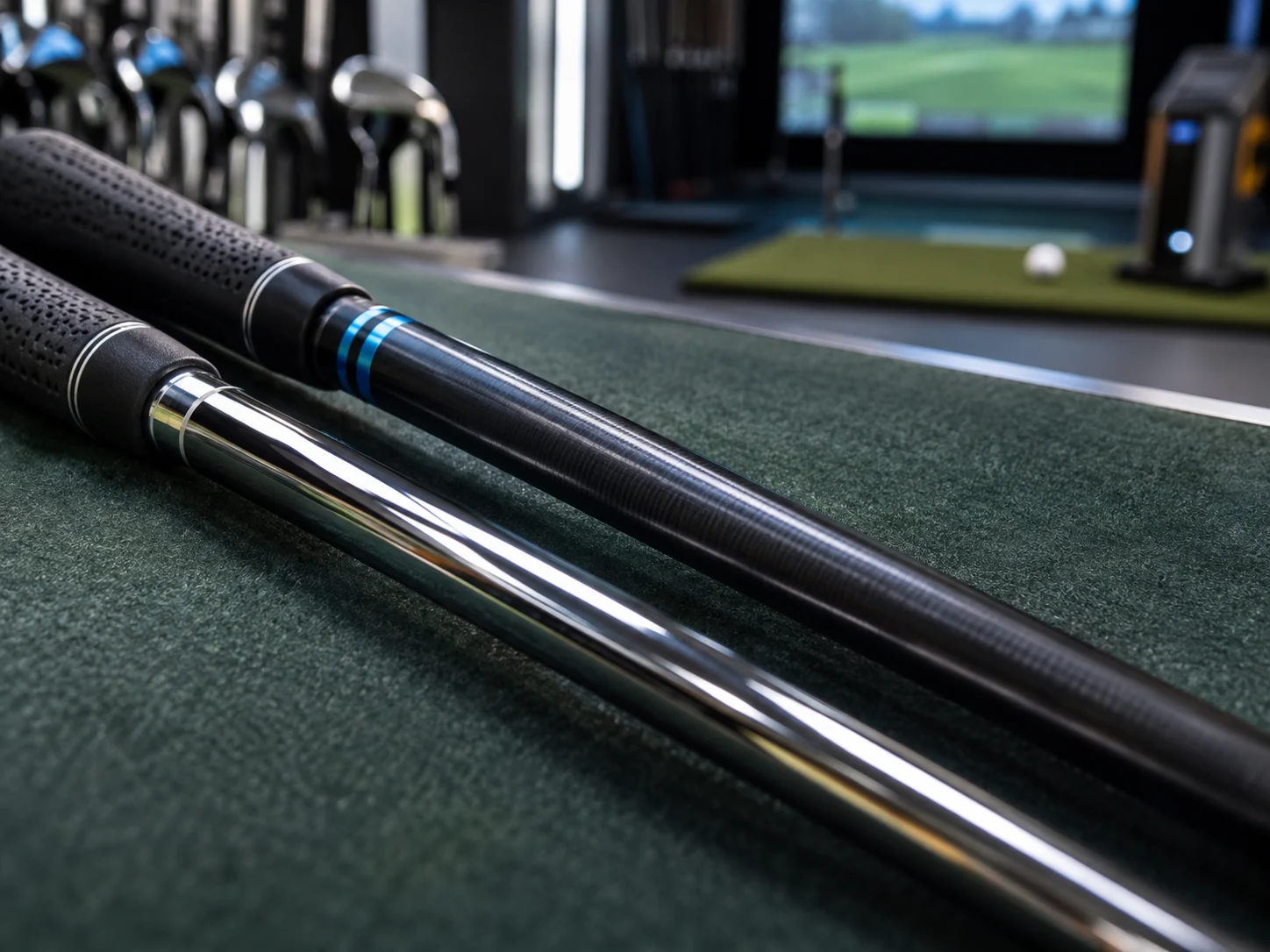
A golfer hits a driver well during a lesson, then visits a shop and is told his swing speed means he needs a stiff shaft. He buys one, plays two rounds, and starts wondering why the new club feels difficult to time. Another golfer has always used regular flex because he does not consider himself a long hitter, even though a different shaft produces noticeably better contact in a fitting.
Both stories expose the same problem. The letter printed on a shaft is easy to read, but it does not tell you everything about how that shaft will behave in your hands.
You do not have to earn a stiff shaft by swinging fast, and there is no shame in playing regular. Your goal is to deliver the club predictably, not qualify for a label.
What does shaft flex actually describe?
A golf shaft bends under changing forces during a swing. Flex is a broad description of a shaft's resistance to bending. Manufacturers commonly label products with designations such as regular, stiff, and extra stiff, sometimes alongside softer categories and numerical ratings.
These designations are useful for organizing choices within a product line. They are not a universal scale. A shaft marked stiff by one company does not necessarily bend the same way as a stiff shaft from another company. Even two shaft models from the same brand can have different bending profiles despite sharing a letter.
That is why the question should not be, “Am I a regular-flex player or a stiff-flex player?” It should be, “Which particular shaft helps me produce repeatable impact and ball flight?”
What happens to the shaft during a swing?
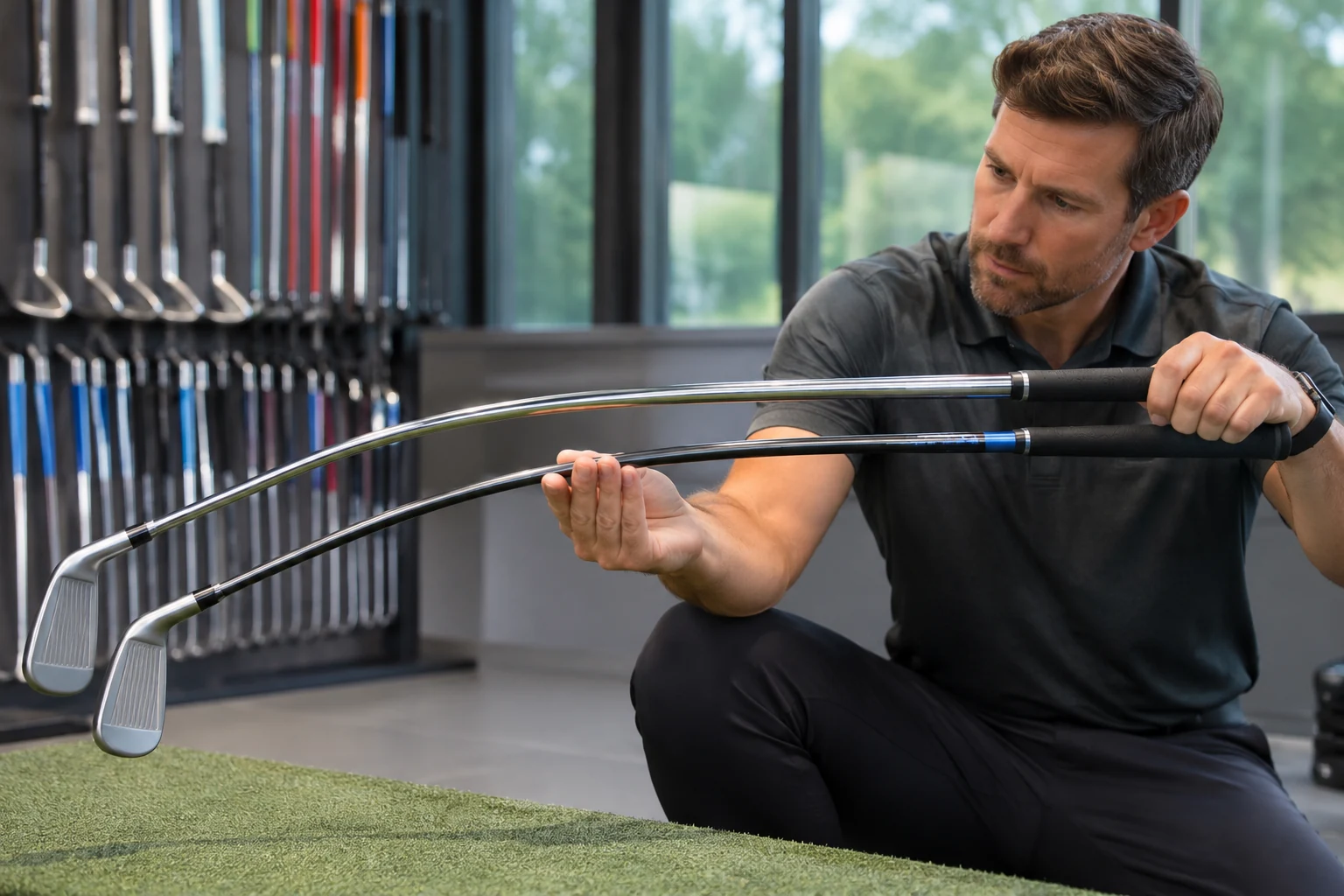
The shaft is not a motionless stick connecting your hands to the clubhead. During the change of direction and downswing, it bends and recovers under forces that depend on the club's motion, mass, and construction. Different sections may resist bending differently.
Golfers sometimes describe a shaft as having a noticeable kick. They may feel it load during transition, or sense the clubhead arriving at impact with a particular timing. These sensations are real, but they do not always translate neatly into one measurable bend characteristic.
A shaft that feels stable to one player may feel harsh to another. A shaft that seems easy to load might feel too active to someone with a different transition. Neither reaction tells us the ball flight without testing it.
Flex is not the same as the entire bend profile
Imagine two shafts both marked stiff. One is relatively firm near the handle and softer in its middle section. Another distributes stiffness differently and has a firmer tip section. They may feel and perform differently even if their overall nominal flex is similar.
Shaft weight, length, torque, balance point, and the assembled clubhead also affect how the club feels. A different label may change several characteristics if you switch models rather than testing two flexes in the same model line.
Why swing-speed charts are useful but limited
A retailer may give recommended shaft-flex ranges based on driver swing speed. Such charts can narrow the initial group of products to test. They cannot determine an ideal shaft by themselves.
First, the boundaries vary between brands. Second, driver speed is not the same as seven-iron speed. Third, two golfers swinging at the same speed can have different transitions and impact conditions.
A player who accelerates smoothly from the top may prefer a different sensation from one who changes direction abruptly. That does not prove the faster-transition player must use stiff flex, but it gives a fitter another important variable to examine.
One other trap is comparing an online chart with a speed estimate based on how far you once hit a drive. Carry distance depends on launch, ball speed, spin, conditions, and quality of contact. It is not a reliable substitute for a measured swing speed.
Use a chart as a conversation starter, then let actual testing settle the choice.
Can a shaft be too stiff?
A shaft can be a poor fit because it feels difficult to load or time, but the symptoms are not universal. You may see reduced speed, different launch conditions, or less consistent contact. Another player could produce a similar ball flight for completely unrelated swing reasons.
Suppose a player feels obliged to swing harder to get a firm-feeling shaft moving. He becomes tense, loses center contact, and hits weaker shots. A different model or flex might make the swing feel less forced. But the improvement may also come partly from a better weight or balance, not stiffness alone.
Avoid diagnosing a shaft from a low shot or a slice. An open clubface, mishit, or unsuitable driver loft can create those results with almost any flex.
Can a shaft be too flexible?
It can also be poorly matched in the other direction. Some golfers find a particular shaft too difficult to time, feel that the head moves unpredictably, or produce a wider pattern of shots with it.
Again, you cannot identify that problem from a high launch or a hook alone. Those results can arise from the player's delivery or the overall club design.
A useful fitter compares the player's ordinary strike pattern and launch conditions with several shaft options. If a firmer option tightens the pattern without sacrificing comfortable speed or launch, there is a reason to consider it. If the supposedly softer shaft performs better, the label should not override the results.
What matters more than choosing the right letter?
Contact location
The first question is whether you can find the middle of the face reliably. A shaft that feels great but pushes your contact toward the heel or toe may not be helping your actual shots.
Try impact spray or tape alongside launch-monitor measurements. Look for a pattern, not a perfect mark on every swing.
Carry distance and its variation
For irons, the difference between your longest shot and your usual shot can be more revealing than maximum distance. If your seven-iron sometimes carries 160 yards but frequently falls to 145, it may be difficult to trust over a bunker.
Directional pattern
Record where shots finish left and right of the intended line. Do not discard every miss. You are buying the shaft for your regular swing, and that includes imperfect contact.
Feel throughout the session
A shaft may feel manageable for three enthusiastic swings and exhausting or awkward after twenty. Let the test run long enough to tell you something about comfort and rhythm.
Consistency under a normal effort
If one option performs only when you make an exaggerated aggressive swing, it may not suit your on-course tempo. Your best equipment should reward the swing you can repeat.

A practical regular-versus-stiff comparison
Consider two hypothetical drivers assembled with the same head, length, loft, and grip. They use regular and stiff versions of the same shaft line. Both feel comfortable after warming up.
| Measurement | Regular option | Stiff option |
|---|---|---|
| Typical carry | 225 yards | 228 yards |
| Most shots within | A relatively tight left-right pattern | A noticeably wider pattern |
| Contact | More centered on average | Some heel and toe movement |
| Player's feel | Easy to swing naturally | Requires conscious effort |
These are illustrative numbers, not results from a real product test. They show why the three-yard difference does not settle the decision. The regular shaft might be the better course option because it offers a more predictable result.
Reverse the dispersion and comfort results, and the stiff option may make more sense. The fitter's job is not to sell the higher flex. It is to understand the entire shot pattern.
Keep shaft weight separate from flex when testing
Here is a common source of confusion: you compare a lightweight regular shaft with a heavier stiff shaft. The second feels slower and less comfortable, so you conclude stiff flex is wrong for you.
But you changed two variables, possibly more. Perhaps a lighter stiff shaft would have been excellent. Perhaps a heavier regular shaft would also have been uncomfortable.
Try to compare different flexes within one model and weight family when practical, then test other weights once the feel and performance become clearer. A thoughtful fitting may test weight before changing flex, especially when the player's tempo or comfort suggests an obvious mismatch.
The steel versus graphite guide covers material and weight choices in detail, without treating either material as a sign of ability.
Driver flex and iron flex do not have to match
A golfer may use a stiff driver shaft and regular iron shafts, or vice versa. That is not a contradiction. Driver and iron shafts differ in length, weight, construction, clubhead pairing, and the shots they are intended to produce.
Do not use the driver letter to order an iron set without testing. A shaft that helps you deliver a driver confidently may not produce the best feel or distance control in a seven-iron.
It can make sense to keep the general feel of the iron set consistent from long to short irons, but there is room for specialty options. Some golfers benefit from a different long-iron profile or a hybrid that fills a useful launch gap.
Should the flex change as your swing develops?
Possibly, but not automatically. If your speed, contact, physical comfort, or swing delivery has changed meaningfully, a fresh fitting may help. That does not mean every improvement in golf requires a stiffer shaft.
A beginning golfer can develop better timing and strike quality without increasing peak swing speed much. A player returning after a long break may find an old shaft tiring or difficult to swing. Those are good reasons to test rather than assume the original specification is still right.
Also consider how you play when tired. A shaft that fits perfectly for your fastest swings at the range may not be the best fit late in an eighteen-hole round.
What about seniors and women's flex labels?
Some brands use categories such as senior, amateur, light, or ladies flex. Those labels are marketing and product-family conventions, not a verdict about a person's age or sex.
The relevant questions remain the same: Does it fit your motion? Can you swing it comfortably? Does it produce consistent contact, carry, and direction?
A golfer should not reject a shaft that performs well because its category name feels unflattering.
Why a fitting can outperform online flex advice
A good fitter starts with your existing club, not a sales recommendation. They observe your normal swing and record an initial shot pattern. They then compare options while controlling variables as carefully as possible.
You should leave knowing the exact model, weight, flex designation, and playing length of the shaft that worked best. If you only remember being told to buy stiff because your driver speed reached a certain number, you did not learn much about the fit.
Ask to revisit the first shaft after trying the alternatives. It is easy for the last club you hit to seem the most impressive simply because you have settled into the session.
And if the different shafts produce almost identical results, you have learned something useful. There may not be a compelling reason to spend money on a change.
Testing from the range to the first tee
Indoor measurements are helpful, but you also want to know whether you can make the same swing outside. If possible, take a candidate shaft to the range and hit a mix of shots rather than ten identical full swings.
Use your normal pre-shot routine. Pick a target. Switch between clubs. Hit one at a time, as you would on the course. Observe where the misses finish, not only where the best shots go.

The point is not to prove that the new shaft is perfect. It is to see whether it helps you play more predictable golf.
Mistakes to avoid when choosing shaft flex
Buying stiff because better players use it. Flex labels do not establish skill.
Buying regular solely because of age. Age does not determine your shaft requirements.
Diagnosing a slice by flex. Impact conditions matter far more than any one printed letter.
Comparing two unrelated shafts. Changes in weight and bend profile can overwhelm the flex comparison.
Using only one swing-speed number. The fitter needs to see normal speed, contact, ball flight, and timing.
Ignoring how the club feels when tired. A fitting should consider playable, repeatable effort.
Buying a replacement before checking the rest of the bag. An iron or driver change can affect distance gaps and club selection. Our full club selection guide covers those decisions.
Common questions about regular and stiff flex
Is stiff flex better for accuracy?
Not inherently. A properly matched stiff shaft may perform better for one golfer, while regular delivers a tighter pattern for another.
Does regular flex always launch higher?
No. Launch comes from the complete club and the player's delivery. The same flex label does not predict identical flight across models.
Can a slow swinger use stiff flex?
Yes, if a particular stiff shaft produces good results and comfortable timing. Swing speed alone is not an absolute rule.
Can a fast swinger use regular flex?
Yes. The player should compare real results rather than assume that speed disqualifies them from a certain label.
Will changing flex fix my hook or slice?
It might change your feel or impact pattern, but it should not be treated as a mechanical fix. Have your face, path, and contact evaluated before blaming the shaft.
Is the flex rating the same in graphite and steel?
No universal comparison exists. Models and manufacturers label stiffness differently, and material does not settle the question.
What to do before ordering
Take your current club to a fitting if you can. Ask the fitter to test comparable regular and stiff options while controlling weight and other specifications. Record carry, dispersion, strike pattern, and how natural each option feels.
Choose the shaft that helps you produce the shot you need most often. If that turns out to be regular, play regular. If it is stiff, play stiff. The ball does not know what letter is printed on the shaft.