

How to Choose the Right Driver Loft for Your Swing

A golfer walks onto the range with a 9-degree driver because it is supposed to produce a powerful, low flight. The ball comes off the face hard, launches like a line drive, and runs a long way across the dry practice ground. It feels like a big hit. On the course, the same golfer faces a forced carry over water and discovers that the ball does not stay in the air nearly long enough.
Another golfer has a 12-degree driver and sends drives high into the sky. The flight looks impressive, but some shots climb sharply, lose forward momentum and land without much roll.
Both players might benefit from a different setup. Neither should make a loft change from appearance alone.
Driver loft affects launch and spin, but it does not work independently of your swing. Clubhead speed, attack angle, strike location, face orientation, head design and shaft characteristics can change how a particular driver behaves. This guide explains what loft really does and how to find a playable flight rather than chasing a number stamped on the sole.
What the loft number on a driver actually means
A driver marked 9, 10.5 or 12 degrees has a stated loft, often called static loft. That specification describes a characteristic of the clubhead in a defined position. It is not the same thing as the launch angle of every shot you hit.
The ball leaves the clubface according to the impact conditions you create. A golfer can deliver more or less loft than the club's nominal value, depending on shaft lean, clubhead orientation, attack angle and other factors. The spot where the ball strikes the face matters as well.
This is why a 10.5-degree driver does not mean the ball must launch at 10.5 degrees. The two measurements answer different questions.
Static loft, dynamic loft and launch angle
- Static loft: The clubhead's nominal loft specification.
- Dynamic loft: The loft presented by the clubface at the point of impact.
- Launch angle: The initial upward angle of the ball's flight.
- Attack angle: Whether the clubhead is traveling upward or downward relative to the ground at impact.
They are related, but not interchangeable. A fitting uses impact and ball-flight information together to understand what is actually happening.
Why more loft sometimes creates more distance
It sounds backward if you grew up hearing that low loft is for long hitters. But a low launch can waste distance when the ball cannot stay airborne long enough to travel to its potential carry point.
Picture a golfer whose driver sends the ball low and fast. The ball rolls a long way on a baked-out range, but a damp fairway or a forced carry exposes the weakness. Adding loft may allow the same golfer to launch the ball higher, improve the flight and carry it farther.
That does not mean increasing loft always improves distance. If a golfer already delivers ample launch and excessive spin, adding more loft may create a flight that climbs too much for their speed and impact characteristics.
The decision depends on the combination of launch, spin, speed and strike. There is no single loft that makes every player hit the longest possible drive.
Swing speed is important, but it does not determine loft by itself
You may have seen charts suggesting a particular loft for a certain driver swing speed. Those can be useful starting points, but they are too simple to finish the decision.
Two golfers can swing at similar speeds and need different driver lofts. One may strike the ball while the clubhead is traveling upward. The other may hit down on the ball. Their delivered loft, launch and spin can be quite different.
Likewise, a player with slower speed may benefit from additional launch, but the exact amount depends on the head, shaft, delivery and strike pattern.
The right question is not 'What loft does a golfer with my speed use?' It is 'What combination of loft and head produces a dependable flight with my swing?'
If you are replacing your first driver, our beginner club buying guide can help you avoid spending money on a head or shaft that does not suit your current game.
Attack angle changes the whole picture
Attack angle describes the vertical direction of the clubhead's travel at impact. A positive attack angle means the clubhead is moving upward; a negative attack angle means it is moving downward.
Many drivers are struck from a tee with the ball positioned forward in the stance, allowing a golfer to meet the ball at or after the low point of the swing. But players deliver the club differently, and an upward strike is not guaranteed.
A golfer who swings upward and produces a useful launch can sometimes play a lower stated loft than a golfer who swings downward at the same speed. That is a possible outcome, not a universal prescription.
Changing loft to compensate for a major delivery problem has limits. A lesson that improves contact and attack angle may be more valuable than continually adjusting the driver.
A simple illustration
Imagine two golfers swinging at about the same speed. Player A consistently strikes upward and launches the ball at a useful angle with moderate spin. Player B strikes downward and produces a low, spin-heavy flight. Giving both players the same nominal loft is unlikely to produce identical results.
In that situation, a fitter should compare not just loft but strike location and how each golfer delivers the club. Otherwise, a change that helps one player could make the other worse.
Strike location can disguise a loft problem
Before deciding your driver is too high-lofted or too low-lofted, look at where the ball contacts the face.
A strike low on the face can produce different launch and spin from a centered strike. High-face contact can also change the flight through the clubhead's impact characteristics. The effect is one reason golfers sometimes get inconsistent launch even when their swing speed seems steady.
Use impact spray or another appropriate contact indicator during practice. Hit several ordinary shots and look for a pattern. If most of your shots miss the center, solving contact may be more important than choosing between 9 and 10.5 degrees.
Equipment matters, but the ball only responds to the club as it arrives at impact.
How loft interacts with spin
Backspin helps shape the ball's trajectory and influences how it stays in the air. Too little spin for a particular launch and speed can lead to a flight that falls out of the sky. Too much can create a flight that climbs, loses efficiency and may be more affected by wind.
Increasing delivered loft often tends to increase spin when other factors are similar, but that relationship is not fixed. Strike location, clubhead design and delivered conditions can alter it.
This is why the lowest-spinning driver is not automatically the longest. A golfer needs an appropriate combination of launch and spin, not the smallest possible number on a screen.
A fitter should examine ball speed, launch angle, spin, carry distance and the overall pattern. If the flight is already efficient, changing loft just to imitate someone else's launch-monitor numbers may make it worse.
How to tell whether your driver launches too low
A consistently low flight is worth investigating when you struggle to carry hazards, frequently land short of your expected distance, or see ball flight that is noticeably flatter than other clubs and fittings would suggest.
But do not diagnose the issue by eye alone. A low flight might come from insufficient delivered loft, low-face strikes, poor contact, swing speed or a combination of factors.
Try a modest loft increase during a controlled session and compare the carry distances. If your carry improves and misses stay manageable, the change may be useful. If the ball merely balloons or curves farther offline, reconsider the diagnosis.
How to tell whether your driver launches too high
A very high shot is not necessarily a bad one. Some players produce excellent carry with trajectories that look high to the eye.
A problem is more likely when measured spin, launch and carry show that the ball is climbing inefficiently or landing substantially shorter than a well-matched setup would produce.
A modest loft reduction can be worth testing. So can a different head, weight setting or shaft. Again, verify that strike location is not creating the flight before blaming the loft.
Adjustable driver hosels: useful, but not magic
Many modern drivers offer an adjustable hosel, allowing you to change loft and sometimes lie angle. Manufacturer systems differ. The adjustment values and their effects are not universal, and changing the setting can also alter the club's face orientation depending on how the golfer addresses and squares the club.
For example, Titleist's SureFit driver hosel provides a set of loft and lie combinations in defined increments. Other brands use different sleeves and labels. Use the manufacturer's instructions for your actual model, not a generic chart found online.
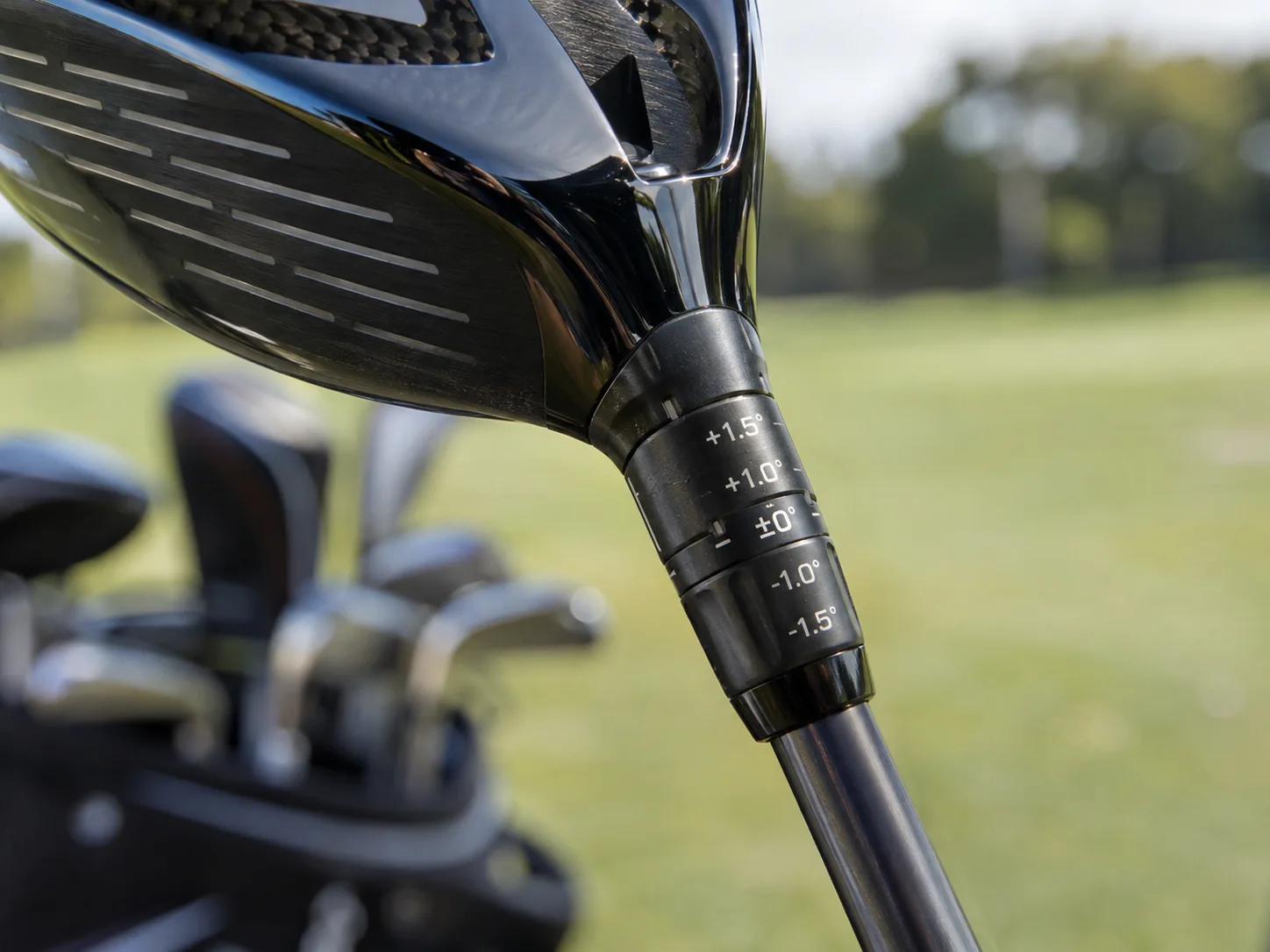
A careful way to test a hosel adjustment
- Record the original setting. Take a photo or make a note so you can return to it.
- Use the correct tool. Follow the manufacturer's directions and torque guidance.
- Change one setting at a time. Multiple changes make it hard to know which difference mattered.
- Warm up before comparing. Do not judge the first ten swings of the day against your best later swings.
- Hit a reasonable sample. Include normal misses and compare carry and direction.
- Return to the original setting. An A-B-A comparison helps reveal whether the change is repeatable.
- Keep the setting that produces useful shots. The goal is not to win a loft argument.
Avoid making mechanical adjustments while the club is in a position where the wrench could slip and injure you. Never force a fitting sleeve or use the wrong torque tool.
Why changing loft can also change direction
Driver adjustment systems often influence more than one geometric characteristic. On some models, a loft setting changes how the head sits or presents when the golfer addresses it. Some systems also offer lie-angle changes.
That means loft adjustments can affect directional tendencies as well as launch and spin. The exact relationship depends on the driver and how you hold the club at address.
A golfer trying to fix a persistent slice should not assume that adding loft alone will solve it. The clubface-to-path relationship and strike are central to curvature. A setup adjustment may help a little, but it cannot repair every swing problem.
To understand the larger equipment picture, read how to choose the right golf clubs for your game.
Carry distance versus total distance
Carry distance is where the ball first lands. Total distance includes the subsequent roll. Loft can change both, and the ground can dramatically change the second number.
Consider two hypothetical driver tests on a firm practice range:
| Setting | Carry | Roll | Total |
|---|---|---|---|
| Lower loft | 210 yards | 28 yards | 238 yards |
| Higher loft | 221 yards | 15 yards | 236 yards |
Those are illustrative numbers, not measured results. The lower-loft setting produces a slightly longer total on hard ground, but the higher-loft setting carries eleven yards farther. If a fairway bunker must be carried at 215 yards, the second result may be far more useful.
Neither setting is universally better. Your course conditions and common landing areas matter. A golfer playing soft fairways should not buy a club based on impressive roll numbers from a dry simulator projection.
Fitting driver loft without being misled by one good swing
An effective fitting begins with your current driver and several ordinary swings. You want a baseline before testing alternatives.
A fitter should ask about your usual ball flight, miss, distance, playing conditions and confidence. Then they can investigate whether a different loft, shaft or head changes the result in a useful way.

What to compare
- Carry distance: Does the ball travel farther through the air on normal strikes?
- Total distance: Does the extra roll matter on the courses you play?
- Ball speed: Are you striking the ball efficiently?
- Launch angle: Is the ball starting on a useful vertical trajectory?
- Spin: Does it support the flight rather than make it climb or fall excessively?
- Dispersion: Are your misses staying in a playable area?
- Strike location: Is the improvement caused by better contact rather than loft alone?
- Comfort: Can you repeat the swing without forcing your tempo?
Ask the fitter to let you revisit the original loft after testing. The most useful decision comes from repeatable differences, not one ideal ball that happened to appear with the newest head.
If shaft feel is a problem, our regular versus stiff flex guide explains how weight and flex influence club delivery without treating the label as a ranking of ability.
A practical starting guide, not a universal chart
You may see golfers grouped by typical driver speed and assigned a loft. Use those charts as broad starting points only.
| Your common pattern | What to test first |
|---|---|
| Low carry with insufficient height | More loft, better strike and launch conditions |
| High flight with too much spin | A modest loft reduction or different head, after checking strike |
| Good carry but a large left-right miss | Face, path, strike and head stability before chasing loft |
| Big differences between high and low face strikes | Contact consistency and tee height |
| Driver works well from tee but not under wind | Flight efficiency and spin, not just a lower stated loft |
| You are new to driving | Forgiving head and sufficient loft to produce playable carry |
A number such as 10.5 degrees is simply a starting option. It is not a diagnosis or a guarantee.
Common mistakes when choosing driver loft
Choosing the lowest loft because stronger golfers use it
Equipment used by professional players reflects their particular speed and delivery. Copying the loft without copying the impact conditions is rarely a sound fitting strategy.
Trying to fix a slice with loft alone
A persistent slice usually needs an examination of face orientation, path and contact. Loft adjustments can influence the result, but they are not a substitute for understanding why the ball curves.
Judging by roll on hard ground
A low shot may run an impressive distance on a dry range yet struggle to carry a bunker or water hazard. Track carry separately.
Ignoring the clubface strike
Low or high face strikes can change launch and spin enough to confuse a loft test. Check contact first.
Changing several settings together
If loft, lie and movable weights all change simultaneously, you may not know what created the improvement. Use a controlled comparison.
Buying without comparing your current driver
A new driver should improve something meaningful. Without a baseline, you are mostly guessing.
Questions golfers ask about driver loft
Is a 9-degree driver only for fast swingers?
No. Swing speed is one factor, but attack angle, delivered loft, spin and contact determine whether a particular golfer benefits from that head.
Will a 12-degree driver always fly higher?
It will generally offer more static loft than an otherwise comparable lower-lofted head, but the actual ball flight also depends on how the player delivers and strikes it.
Does increasing loft reduce a slice?
Not reliably. Adjustments may change flight and directional tendencies on some drivers, but a slice is strongly influenced by face-to-path conditions and strike.
Should I adjust my driver myself?
You can when your manufacturer provides an adjustable system and clear instructions. Use the correct wrench, follow its settings and verify the result on the range. When uncertain, ask a fitter.
Is launch angle the same as loft?
No. Loft is a club specification or delivered face condition, while launch angle describes the ball's initial trajectory.
How often should I revisit my loft?
When your speed or delivery changes substantially, or when testing suggests a measurable flight problem. There is no need to adjust a driver that is performing consistently just because you have not touched the hosel recently.

The best loft is the one that produces a playable flight
There is no prize for playing the lowest-lofted driver, and no need to apologize for playing one with more loft. If a higher-lofted head carries farther and leaves your normal misses in better positions, it may be the smarter choice. If a lower-lofted head provides a more efficient flight without sacrificing carry or control, that may be right for you.
Start with strike quality and the flight you actually see. Measure carry and spin if you can. Change one variable at a time, and keep the setting that produces a useful pattern across normal swings.
The right driver loft is not the one another golfer recommends without seeing you hit. It is the one you can trust when the tee shot matters.